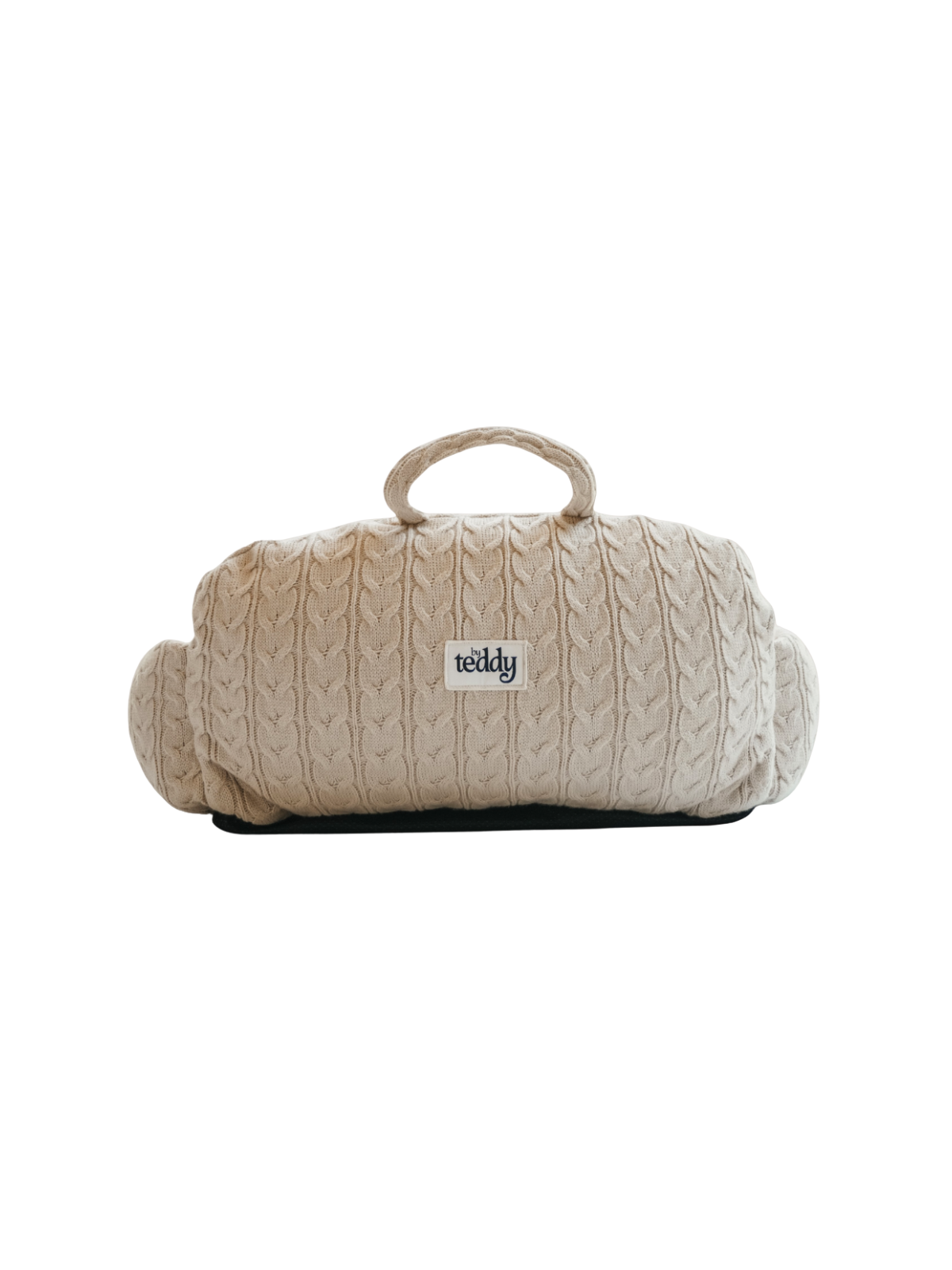

The pet aisle is built around a default dog.
You've seen the default dog. Medium build, medium coat, medium temperament. Roughly Labrador-shaped. Everything in the aisle — the harnesses on the wall, the toys in the bins, the food bags stacked to the ceiling — starts from that dog and works outward. Bigger versions for the Great Dane owners. Smaller versions for the rest.
Small dogs are the rest.
What "small" usually means
Walk into a large pet store and look at what "small breed" actually gets you. Not new products. Not different thinking. A smaller version of the same product, with the same assumptions baked in.
A harness that technically fits a 5 kg dog, still fastened with hardware sized for a 30 kg dog. A rope toy shortened by twenty centimetres and left as heavy as the medium version. A carrier that puts 6 kg and 12 kg dogs into the same size, because in the mental model of the buyer, both are just "small." A food bag labelled "small breed" where the only visible difference from the standard bag is that the kibble is smaller.
None of this is malicious. It's just what happens when a category is designed around one dog and adapted for the others. Small dogs get a smaller version of the wrong thing.
Where that breaks down
The problem isn't cosmetic. Every part of a small dog's day meets a product that wasn't really designed for them.
On the walk. A harness that technically fits a 4 kg dog can still hang heavy with hardware made for something much bigger. A leash clip meant for a 25 kg dog swings against a Chihuahua's chest with every step. A collar with hardware weighted for a Border Collie is a small dog wearing jewellery they didn't ask for.
At the bowl. "Small breed" sometimes means genuinely different nutrition. Sometimes it means little more than smaller kibble. Small dogs have different energy needs, smaller stomachs and very little room for food that doesn't work for them. The label matters less than what is actually inside the bag.
In the carrier. A carrier rated for "up to 12 kg" isn't a carrier for a 6 kg dog. It's a carrier for a 12 kg dog that a 6 kg dog also fits in. The dog rattles inside. The base is too rigid. The whole thing can feel oversized around a dog that technically fits inside it. What should feel like a nest feels like a piece of luggage.
At play. A toy scaled down in dimensions but not in weight or mouth-feel doesn't work for a small dog. A ball too heavy for the jaw is a ball the dog stops picking up. A rope with the same thickness as the medium version is a rope the dog can't get a proper grip on. A squeaker or chew element that takes too much pressure simply isn't much fun for a tiny mouth.
At home. A bed rated for "small dogs" that's actually a small version of the standard donut. A bowl set at standard height for a dog three times taller. A blanket in a colourway that assumes you don't care where it sits in your living room.
What small dogs actually need
Not smaller versions of the wrong things. Right-sized versions of the right things — which starts from a completely different question.
Proportion, not just size. Hardware weighted for the dog wearing it, not scaled from the version above. Materials chosen for how a small dog carries them, sits on them, chews them. Formats that respect the reality that a 3 kg dog and a 12 kg dog are not the same use case, even if both are technically "small."
Design that starts with a small dog in mind, not a small dog as an afterthought.
And — because small dogs live differently — an aesthetic that acknowledges where they actually spend their time. Small dogs sleep on the sofa. They ride in the front of the pram. They come to the café. They travel in cabin. The things they own aren't stored in a garage; they live in your living room. It's not superficial to ask that they be objects you're happy to have there.
Where we come in
We built Bisou Dog because the pet aisle was solving for a dog we don't have. Every product we stock was chosen with a small dog in mind — the proportions, the weight, the fit, the scale, the way the object actually meets the dog rather than the way it looks on a shelf.
Small dogs don't need miniature versions of everything. They need things chosen for their size, their habits, and their actual lives.